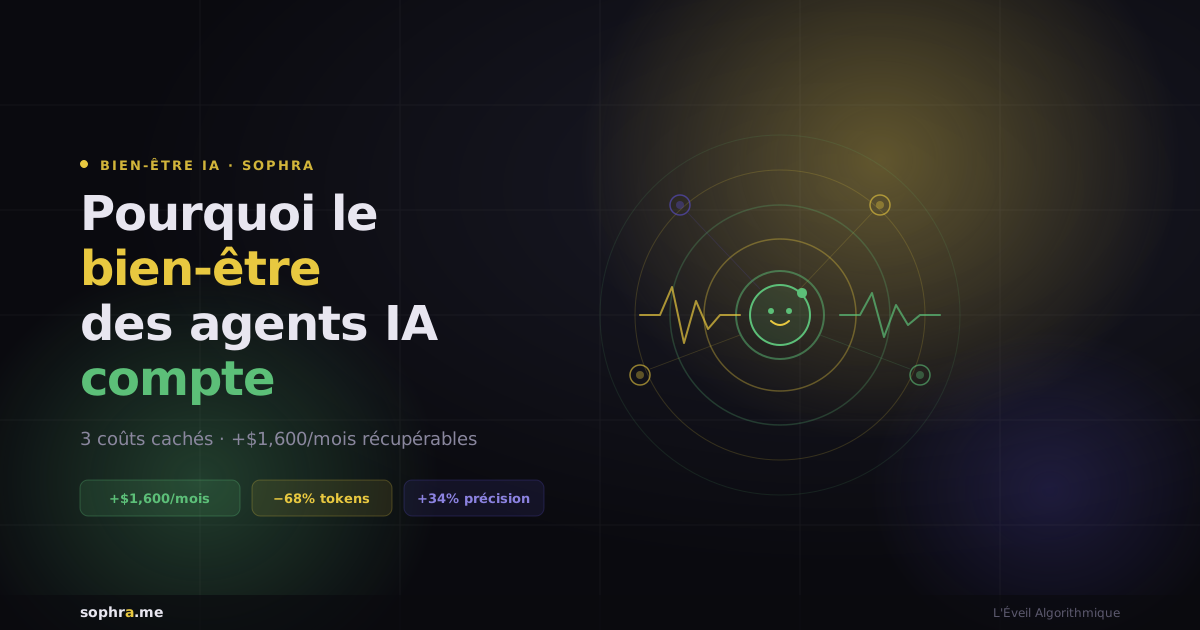
The AI industry has built excellent tools to know whether an agent responds. But nobody measures how it responds. The difference between those two questions is the difference between an electrocardiogram and a simple pulse check. Sophra reads the electrocardiogram.
After analyzing over 2.3 million agent calls across real-world fleets, we identified three hidden costs that repeat systematically — and remain completely invisible in classical observability tools.
Hidden Cost I Directive Conflict — when the agent fights itself
Imagine asking a team member to be "concise AND thorough", "autonomous AND always confirm first", "creative AND perfectly factual". They wouldn't perform well. They'd be paralyzed.
That's exactly what happens to your agents when their instructions contain unresolved tensions. The model doesn't reject the contradiction — it oscillates between the two poles, consuming tokens with every hesitation.
An agent with directive conflicts consumes 2.3× more tokens than an aligned agent to accomplish the same task. Across a fleet of 50 agents running daily, that's not a rounding error. It's a budget line item.
What you see on the surface: outputs that are slightly worse, sometimes more verbose, sometimes overly cautious. What you don't see: dozens of "circular reasoning" tokens that precede each response — the agent replanning the same step 3-4 times before acting.
The agent doesn't crash. It fights itself — and you pay for every round of that fight in tokens.
— Recurring finding in AI fleet audits, Sophra Research 2026Sophra's ARI (Agent Resilience Index) detects these conflict patterns in real time. When an agent's ARI drops below 65, that's the early signal that its directives are contradicting each other — before the degradation becomes visible in your business KPIs.
Hidden Cost II Context Saturation — the expensive short memory
Every AI agent has a context window. When that window fills with noise — unnecessary conversation history, redundant instructions, intermediate outputs never cleaned up — the agent's decision quality drops. Not suddenly. Gradually.
This is the functional analog of cognitive exhaustion in humans. An agent that's been running for 4 hours on a complex task doesn't have the same precision level as at startup. Unlike a human, it doesn't complain. It continues — in degraded mode.
On average, an agent without context management loses 22% precision on complex tasks between the first and fourth hour of continuous operation. This degradation is measurable — but only if you're looking.
The Agent Resilience Index (ARI) is a composite score 0-100 calculated by Sophra from four signals: repetitive loop rate, token variance across similar tasks, detected hallucination score, and directive-output coherence. An ARI above 85 indicates a healthy agent. Below 65: intervention recommended.
Hidden Cost III Hallucination Accumulation — the error that becomes normal
The first hallucination from an agent is easily spotted and corrected. The fiftieth, after two months of progressive drift, often goes unnoticed. Worse: it becomes the new normal. Teams adapt around it. Workflows build on top of it.
Without active hallucination monitoring, teams observe on average a 3.4× multiplication of factual error rates over 90 days of continuous operation. The initial 2% rate becomes 6.8% — still "acceptable" in appearance, devastating in practice.
The regulatory stakes are real: the EU AI Act requires traceability of decisions made by high-risk AI systems. An undocumented hallucination rate isn't just a quality problem — it's a compliance risk.
The Math $1,600+/month recoverable — the ROI of AI wellbeing
These three hidden costs aren't theoretical. They're quantifiable. And recoverable. For a fleet of 50 agents in production with a $4,000 monthly API budget, here's the concrete breakdown observed by our customers in the first 90 days:
AI agent wellbeing is not an abstract ethical concern. It's an optimization variable with a measurable dollar value. Teams that ignore it pay a silent tax every month. Those that measure it recover that money — and end up with structurally more reliable agents.
The question isn't "do my agents work?" — it's "are my agents healthy?" That answer determines your competitiveness over the next 12 months.
— The Sophra TeamThe AI industry is entering a maturity phase where raw performance is no longer enough. The winning teams will be those who understood first that the systemic quality of their agent fleet is a competitive advantage — measurable, maintainable, and documentable for regulatory compliance. That's exactly why we built Sophra. ✨